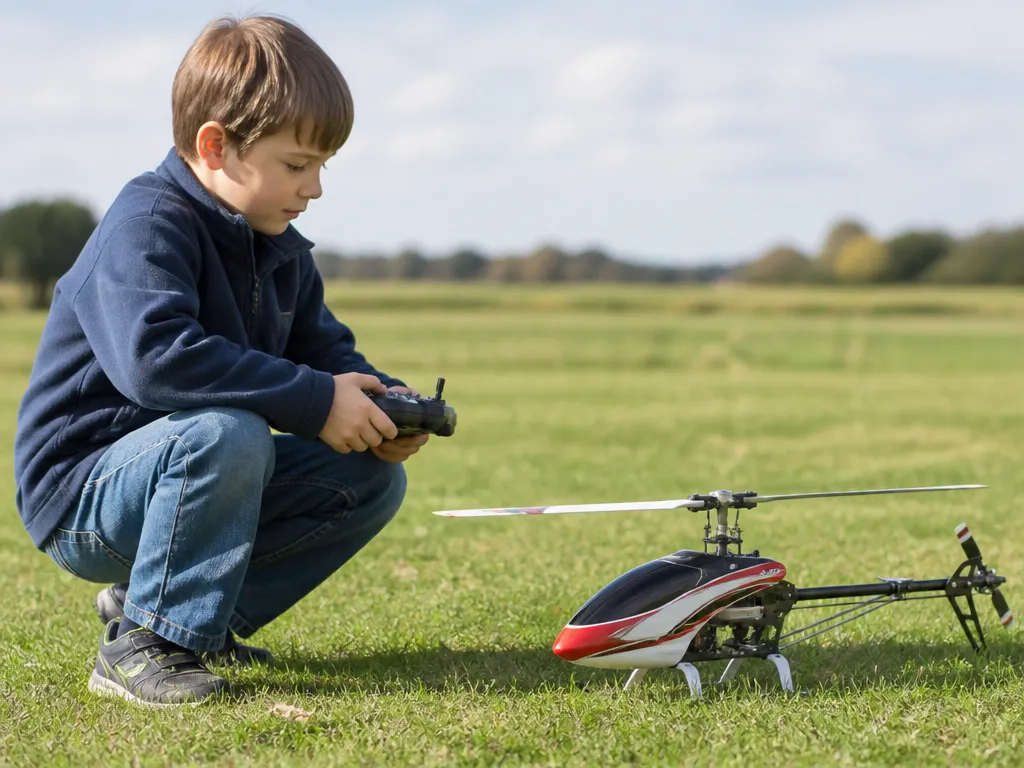
The best all-around choice is a beginner indoor helicopter with 3.5-channel control, a 2.4 GHz radio, altitude hold, and gyro stabilization. That combination keeps the helicopter level while a child learns to steer, and some kits provide up to 30 minutes of flight time with two batteries.
For younger children, a single-lever, auto-hover model rated for ages 3 and up is easier to operate. Kids who crash frequently may do better with the Cheerwing S107G, while the SYMA S107H-R offers a durable three-channel alternative. The Deerc DE51 suits longer sessions, the GoolRC C129 fits smaller spaces, and the Droneeye 4DM5 is aimed at households using several remotes.
| Model (type) | Key Spec | Best For | Trade-Off |
|---|---|---|---|
| Beginner indoor stabilized RC helicopter (3.5-channel, 2.4 GHz) | 3.5-channel, 2.4 GHz radio, altitude hold + gyro, up to 30 min with two batteries | All-around first helicopter for kids and beginners | Indoor-only style flying and learning curve still exist |
| Beginner indoor RC helicopter (single-lever, auto-hover) | Single-lever steering, auto-hover, age 3 and up | Youngest pilots | More toy-like control limits than 3.5-channel helicopters |
| Cheerwing S107G (crash-resistant) | Built as crash-resistant with a small outdoor-friendly build | Kids who crash a lot | Outdoor use can encourage higher speeds and harder recoveries |
| SYMA S107H-R (durable) | Durable beginner pick with three-channel free movement | Durable training flights | May feel less hover-friendly than altitude-hold models |
| Deerc DE51 (longer-lasting) | Built for longer-lasting sessions | Kids who want more flight per day | Flight-time details vary by kit, so check the specific listing |
| GoolRC C129 (compact) | Compact indoor/outdoor-friendly build | Small spaces and simple sessions | Less forgiving in gusty or cluttered areas |
| Droneeye 4DM5 (non-jamming function) | Non-jamming function, three-channel-style control | Busy households with multiple remotes | “Non-jamming” still does not replace spacing and practice |
Key Takeaways
- Best all-around pick: Choose a beginner helicopter with altitude hold and gyro for the fastest learning curve.
- Prioritize stabilization: Gyro-based models reduce tip-overs, especially on first flights indoors.
- Match channels to skill: 3.5-channel control is a useful middle ground for kids learning coordinated movement.
- Plan for battery swaps: Some top picks reach up to 30 minutes by using two batteries.
- Choose the right frequency: 2.4 GHz radios generally handle household interference better than older toy remotes.
- Expect crashes: A protective shell and flexible parts matter more than ambitious speed claims.
Crash-Resistant RC Helicopters for Indoor Beginners
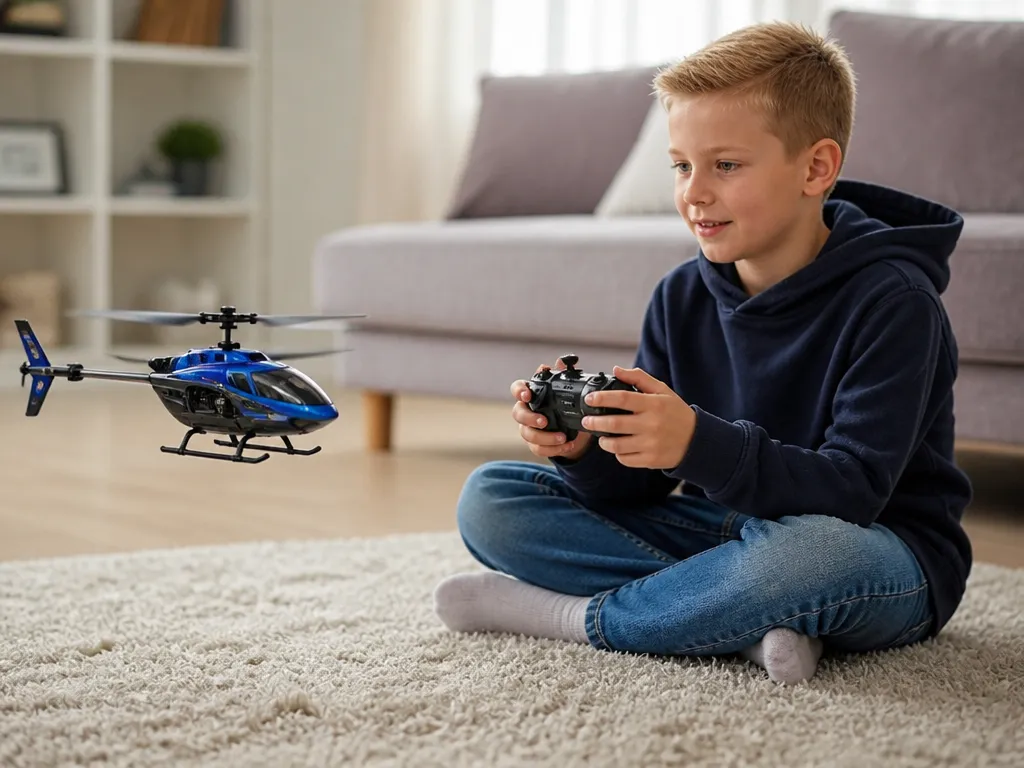
Indoor beginners need a helicopter that can survive repeated tip-overs, not one that promises to be indestructible. A protective frame or shell helps, but stabilization matters just as much. A helicopter that oscillates violently after a small control mistake will hit walls, furniture, and ceilings harder.
Stable hovering gives a child time to understand the controls instead of constantly correcting a dive.
Very young pilots should use an even simpler layout. A model with single-lever steering and auto-hover, rated for ages 3 and up, reduces the number of controls a child must coordinate. It lets them practice direction and basic takeoff without immediately managing several control axes.
The trade-off is agility. Crash-resistant beginner helicopters are usually slower and less responsive than sportier models. That is an advantage for a child learning indoors. A fast helicopter can encourage rushed inputs and panic corrections, while a slower model rewards steady steering.
What Makes an RC Helicopter Durable Enough for Kids?
A durable helicopter should withstand repeated tip-overs and low-speed collisions. Flexible parts, a protective cover, and components that do not shatter on contact will keep a minor mistake from ending the session or damaging the helicopter.
Clear flying space matters just as much. Even a crash-resistant frame will wear out if the helicopter repeatedly hits walls or furniture at full power. Remove loose decorations, move pets and siblings away, and create a landing area before the first flight. Treat open space as part of the helicopter’s safety equipment.
Match the Helicopter to Age, Skill, and Flying Area
Age is only a rough guide. Hand-eye coordination, attention span, and available space matter more. A 7-year-old who follows “slow and steady” instructions may handle a stabilized 3.5-channel helicopter sooner than a 10-year-old who immediately pushes the controls to full power. A 3-year-old will usually benefit from single-lever or auto-hover controls rather than a multi-axis setup.
For indoor flying, choose a room with smooth floors, clear space around lamps and furniture, and enough height to avoid ceiling impacts. Ceiling fans and tall bookcases create hazards that no channel count can solve.
Use this matching guide:
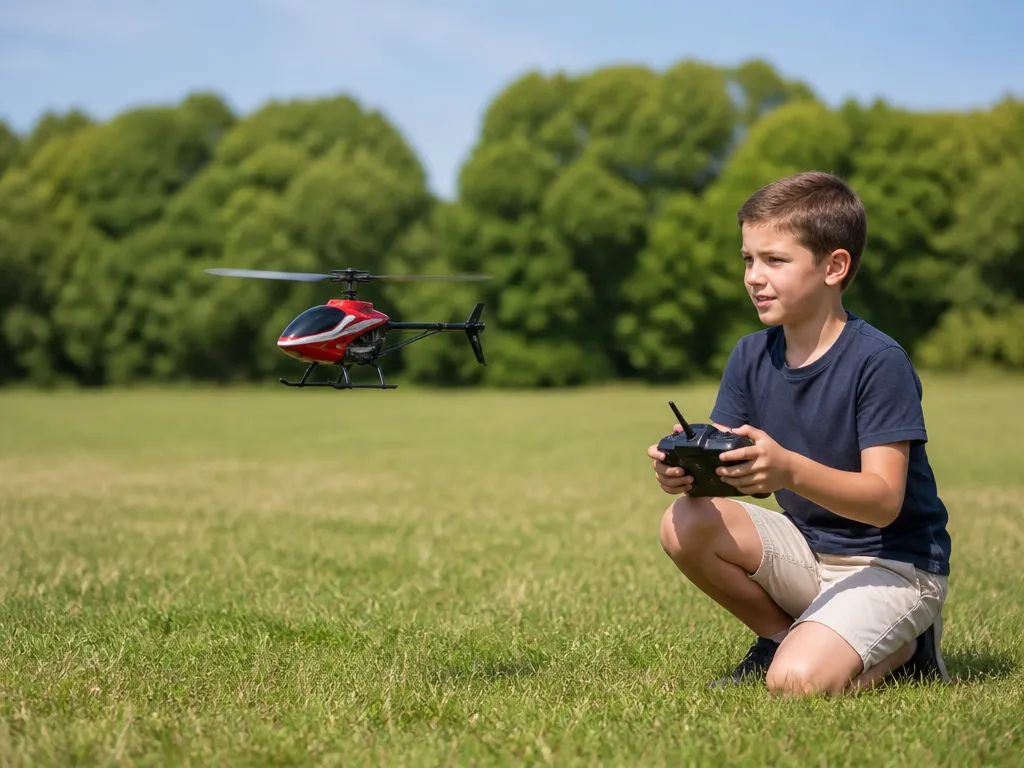
- For ages around 3 to early beginner, prioritize auto-hover or single-lever steering.
- For children who can follow “slow and steady” instructions, choose altitude hold + gyro and 3.5-channel control.
- For outdoor beginners, keep stabilization as a priority, but account for wind. Gusts amplify every control error.
Indoor practice is mostly about hovering, orientation, and gentle landings. Outdoor flying adds wind, which makes stabilization helpful but less effective. The right first helicopter is the one that behaves predictably in the space where your child will actually fly.
A small living room calls for an indoor-first stabilized model. A garage or covered patio with open space and no ceiling obstacles can accommodate a crash-resistant outdoor model once your child can take off, hover, and land without chasing the helicopter.
Battery Life, Channels, and Control Complexity
Battery life often ends a beginner session before a child has had enough practice. Some indoor beginner models provide up to 30 minutes with two batteries, which makes it easier to continue learning without waiting after every short flight. A kit with only one battery will produce shorter sessions and more charging interruptions.
Channels determine how much the child must coordinate. In practical terms, 3.5-channel control gives a child more authority than a simple toy layout, while stabilization prevents the helicopter from constantly fighting the pilot.
A single-lever model with auto-hover and an age rating of 3 and up reduces the mental workload further. It is a good fit when the goal is to learn direction and hovering before introducing more complicated stick movements.
Choose stronger stabilization through gyro, altitude hold, or auto-hover when a child cannot keep the helicopter near one spot. Once the child can hover and land consistently, a more involved control layout makes sense.
Responsiveness matters, too. Some helicopters feel jumpy immediately after takeoff, especially when the throttle moves too quickly. Start with gentle power and short hovers. Full-power launches teach panic corrections rather than controlled flight.
Check the Battery Count Before Buying
Verify whether the box includes one battery or two batteries. A two-battery kit is more likely to deliver the advertised up to 30 minutes of total session time. A one-battery kit may still be suitable, but expect shorter flights and more time between attempts.
Frequency, Interference, and Safe Range
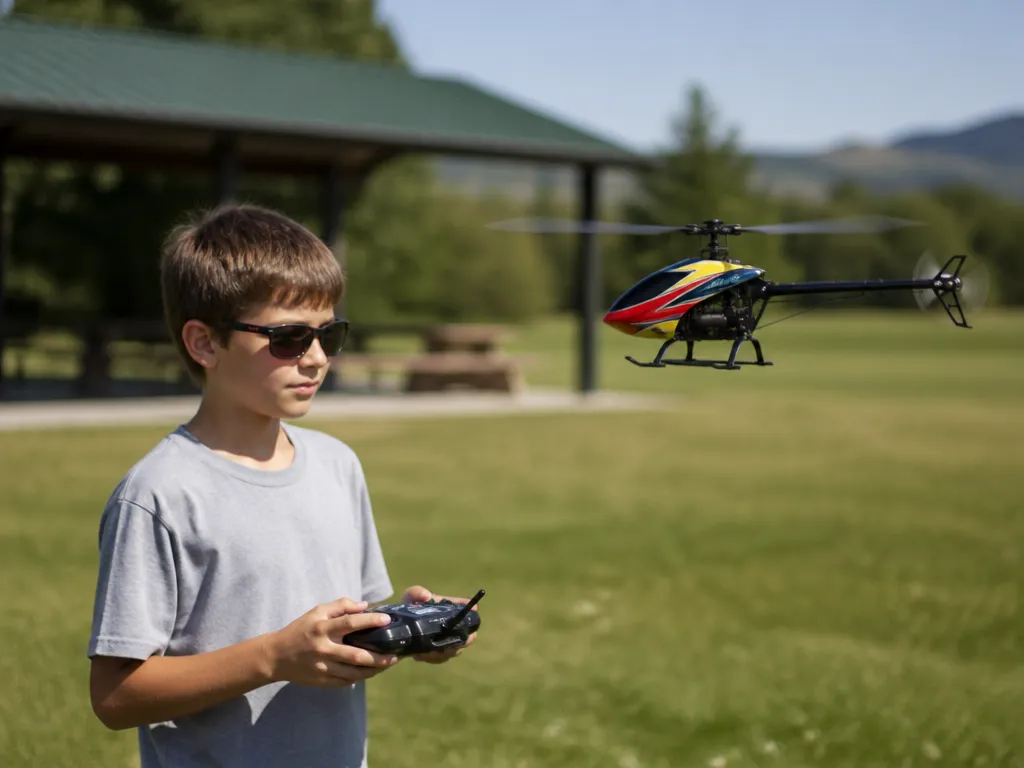
Frequency becomes most important when several remote-controlled toys operate in the same home. Kid-focused helicopters commonly use 2.4 GHz radios, which are generally a better baseline than older toy remotes that are more prone to interference. One leading beginner setup specifically includes a 2.4 GHz radio.
Signal quality also depends on line of sight, obstacles, room layout, and the number of nearby controllers. If several family members fly at once, pair each helicopter correctly and give the pilots enough space. A higher stated range is not especially useful for a young child who should remain within direct supervision.
For most U.S. households:
- Choose a 2.4 GHz model for the best chance of stable control in a typical home.
- If the helicopter behaves erratically, move it away from dense obstacles and nearby electronics before blaming Wi-Fi.
- Keep the helicopter inside a clear, supervised “kid bubble” so the child is not making sudden corrections at the edge of the signal.
The Droneeye 4DM5 is listed with a “non-jamming function,” which may help in a busy household. Treat that as a design feature, not a guarantee that several helicopters can fly close together without confusion. Good spacing and one-at-a-time practice are still the safer approach.
Interference may appear as delayed responses, twitching, or an inconsistent control feel. Reposition the helicopter, remove obstacles, and confirm that the remote and helicopter are paired correctly.
Best RC Helicopters by Feature and Trade-Off
Best All-Around: Beginner Stabilized 3.5-Channel Helicopter
Altitude hold reduces the constant throttle corrections that overwhelm new pilots. Gyro stabilization keeps the helicopter more level, while the extra control authority gives a child room to progress beyond basic hovering. The indoor-first design also keeps the learning environment predictable.
The trade-off is outdoor performance. Calm air may be manageable, but open wind can overwhelm a small indoor helicopter. The stabilization helps, but it will not make an indoor model immune to gusts.
Best for the Youngest Pilots
A simple single-lever, auto-hover model offers the simplest introduction. It reduces the number of simultaneous decisions and lets a young child focus on direction, takeoff, and landing.
This setup is easier to understand than a 3.5-channel helicopter, but the simplicity limits future control. A child who quickly wants faster sideways movement may outgrow it sooner.
Most Crash-Resistant Pick: Cheerwing S107G
The Cheerwing S107G is positioned as a crash-resistant option with a small build intended to handle frequent beginner impacts. One kid-focused list also mentions built-in lights, which can make the helicopter easier to track during indoor sessions.
Crash resistance reduces the cost of mistakes, but it does not make uncontrolled flying safe. Repeated full-power impacts will eventually fatigue even a durable frame. Keep the first flights slow and low.
Durable Training Pick: SYMA S107H-R
The SYMA S107H-R is a durable beginner helicopter with a three-channel system that provides free movement in every direction. That extra movement can help a child progress beyond simple hovering, and the model is commonly treated as a training option that can tolerate repeated crashes.
The trade-off is a more active control feel. Compared with an altitude-hold model, it may require more careful stick work to maintain a steady hover. It suits a child who is ready to practice control rather than simply press an auto-hover button.
Best for Longer Sessions: Deerc DE51
The Deerc DE51 is positioned as a longer-lasting option for children who want more flying time each day. It makes sense when the main source of frustration is running out of battery before the child is ready to stop.
Flight-time details vary by kit and battery configuration. Check the exact listing before buying, especially if predictable sessions are important. Confirm whether the package includes one battery or two.
Best Compact Option: GoolRC C129
The GoolRC C129 is often described as compact and suitable for indoor or outdoor use. Its smaller footprint makes it easier to keep within a defined practice area, which helps families with limited space.
Compact helicopters are not automatically easier to fly. The C129 may be less forgiving in cluttered rooms or gusty air, so clear a landing area and keep the first flights low and slow.
Best for Busy Households: Droneeye 4DM5
The Droneeye 4DM5 is listed with a “non-jamming function,” making it a reasonable option for homes with multiple RC toys or remotes. The feature is intended to reduce control problems when other devices are operating nearby.
It cannot replace good operating habits. Two helicopters flying too close together can still create confusion, even with anti-interference features. Separate play sessions or give each pilot a clearly defined area.
First-Flight Safety Setup
A safe first flight depends more on preparation than on advanced technique. Use this checklist with any kid-focused RC helicopter:
- Clear the room zone. Remove loose decorations and create a full landing runway.
- Move pets and siblings away. Small rotors can still cause injury.
- Check the battery. Make sure the pack is fully seated and the contacts are clean.
- Test the remote. Confirm smooth response for 10 seconds before takeoff.
- Use slow takeoff or one-key mode. If the model includes one-key takeoff or landing, use it.
- Stay at chest height or lower. Lower indoor flights reduce ceiling and lamp strikes.
- Practice one movement at a time. Hover for 10 seconds, then land before adding turns.
- Land when control feels uncertain. Ending the flight early is safer than trying to recover a drifting helicopter.
Floor airflow, vents, static drafts, and ceiling fans can all make a helicopter drift. If it consistently moves in one direction, do not keep chasing it with the controls. Move to a calmer area and try again.
Altitude hold and auto-hover should function as training wheels. Your child’s first goal is not perfect control; it is learning which stick movement brings the helicopter back toward center.
Use a protective frame or shell when the model includes one. If the helicopter has little rotor protection, reconsider whether the room and the child’s skill level are suitable for indoor flying.
Supervise the first several sessions closely. Once your child can land within a few seconds of the intended spot, gradually allow more control over the flight path.
FAQ
What is the easiest RC helicopter for a 4-year-old to fly?
Prioritize a simple indoor model with limited controls. That setup reduces the coordination required and makes hovering easier than managing several control axes at once.
How long do RC helicopters for kids usually fly per session?
Flight time depends on whether the kit includes one battery or two. Some beginner indoor models provide up to 30 minutes when using two batteries. A two-pack makes longer sessions easier, while a one-battery kit requires more charging between attempts. For training, 10 to 15 minutes per battery is often enough to learn without causing burnout.
Are 2.4 GHz RC helicopter remotes better for home use?
2.4 GHz radios are usually the better default for home use because they are common in modern RC controllers and generally handle household interference more reliably than older toy-frequency systems. A leading beginner setup specifically lists a 2.4 GHz radio. Obstacles and room layout still affect the signal, so keep flights within a supervised indoor zone.
What should I do if my child’s helicopter keeps drifting during hover?
Move the helicopter away from vents, fans, and other sources of airflow, then retry a short hover. Confirm that the battery is seated correctly and that the helicopter is paired with the remote. If the drift remains extreme and consistent, the model may need trim or stabilization adjustment.
What is the most common mistake when buying a first RC helicopter for kids?
Buying a model that is too complex for the child and the available space. Match the controls to the child’s current skill level. Speed and agility are poor priorities for a first indoor helicopter if the room is cluttered or the child is still learning to hover. Start with stability, then move to more demanding controls.
1 thought on “Best Rc Helicopters For Kids”